
Workers Resist Manifesto
-
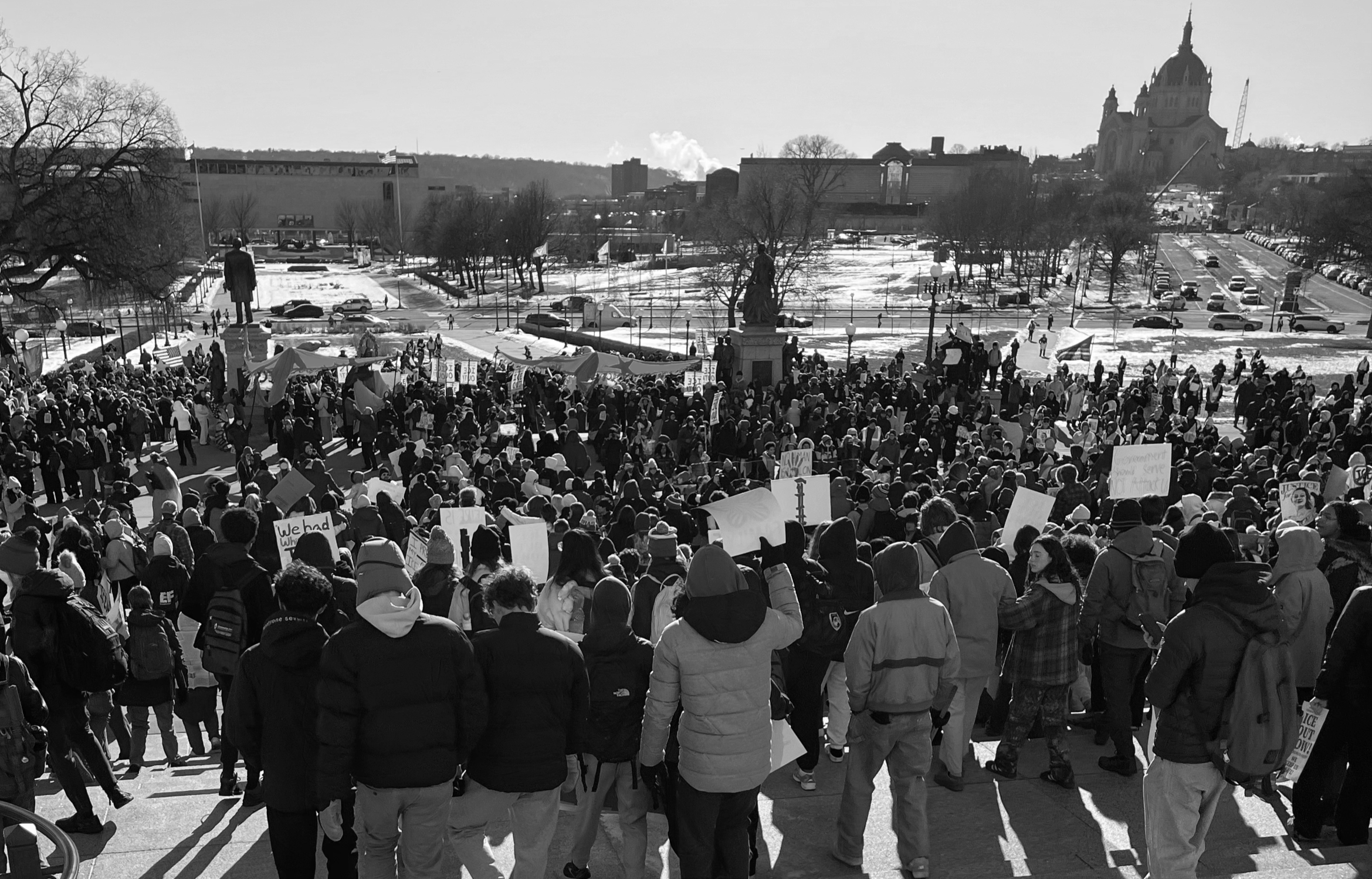
We launch this Manifesto in the middle of a clear political crisis and increasing instability of U.S. capitalism. There has never been a greater concentration of wealth among so few in the history of this country, not even in the so-called Gilded Age at the turn of the twentieth century. We all work longer hours to keep ourselves afloat, seeing our families less and less simply so we can pay the rent or mortgage. We witness a murderous genocide of the Palestinian people by the U.S. and Israel. Meanwhile there is a war with Iran, with no apparent off-ramp, that pushes us toward even greater conflict and drives up the price of every commodity we need to live. Parts of Reno, Nevada and Spokane, Washington are devoured by wildfires while other wildfires make the air in huge swaths of the country unbreathable. Our neighbors, people many of us have known and worked with for years, are hunted by ICE simply because they were not born in the United States. Those who try to protect them are gunned down in the streets of Minneapolis and other cities. But there is a growing nationwide movement of resistance. The cries against ICE, rising cost of living, bad jobs, war, genocide, and climate catastrophe have grabbed the public’s attention and participation with massive street actions, confrontations with police and urban revolts in cities like Los Angeles, Chicago, and Minneapolis.
The resistance to ICE in Minnesota gives us a clear blueprint of how we can push back an authoritarian regime. There was the defensive struggle of rapid response and mutual aid networks, which built deep connections in and between working class communities, and the offensive struggle of mass demonstrations and particularly the mass strike of January 23. Combined together these vehicles of working class power forced 60 major Minnesota based corporations to publicly call for a draw down of ICE forces on February 1. DHS chief Tom Holman came to Minneapolis several days later on February 4 as a result and announced the withdrawal of most ICE officers. Mass working class struggle gets the goods.
Trump and the far right have torn the mask from the system. Millions can now see the “us and them” that has always defined capitalism. The ruling class is open about its greed; the state is open about its repression. Workers who organize, strike, defend their neighbors, or stand in solidarity increasingly face retaliation designed not only to punish individuals but to intimidate entire movements. We can see this clearly with the persecution of groups like the Minnesota 15, the Righteous 39, Prairieland defendants and the Michigan 8. Our response cannot be fear or isolation. There must be deeper and broader organization and stronger solidarity. If we do not come to the aid of those who the government seeks to repress now, in the future others will be less likely to take risks in the fight against authoritarianism and those who do fight will be less able to defend themselves.
Yet this crisis is also a gift. It clarifies that there is no savior coming — no candidate, no non-profit, no enlightened billionaire. Only organized workers can save themselves.
The Democratic Party has shown that it can’t (and won’t) stop the right. In Minnesota Jacob Frey, a Democratic mayor, allowed the Minneapolis police to actively assist ICE in their dirty work. He was joined in this by the Democratic governor, Tim Walz who let the Minnesota State Police be a protective force for ICE. In fact, the neo-liberal regimes the Democrats helped lead are responsible for the crisis we now face. It isn’t time to save the Democratic Party but to find the solution within our own forces. The need for a new party built and controlled by workers is the most crucial problem on today’s political agenda. While we can’t create a new mass socialist party out of thin air, we can begin to assemble the forces that recognize the pressing need for doing this now.
We also need to recognize that a new workers party can not simply be an electoral formation. Electing workers and socialists to legislative bodies and especially to executive positions like mayor or governor does us little good if we are not building deep roots in the actual struggles of the working class. Without a powerful mass movement of the working class, the people we elect will, in the long run, either get driven from office or co-opted into the Democratic Party and the ruling class camp.
We must also guard against this cooptation of our movement. Coming out of the fight against ICE and protection of democracy there is substantial energy, energy the ruling class fears. The corporate class is using its money and influence to have leaders of major unions, non-profits and left wing organizations lead this energy back into the Democratic Party. We can see this in the activities of left wing politicians like Bernie Sanders, AOC and now Mamdani.
We refuse to surrender our movement to left liberal politicians who use our votes but fear our power.
Electoral politics can amplify our demands, but only class struggle can win them.
Nobody’s coming to save us but us.
-
We are workers. We are class-struggle unionists, non-union workers trying to unionize, community activists, tenant organizing activists and socialists. We come together in the labor movement and the workers movement because it is the one terrain where working people already possess the collective organization and strategic power to challenge capital. Across many frontline industries, where exploitation is often most intense, workers also hold the greatest potential to transform society through collective action. Building leadership there is central to our strategy.
We know that the workplace is where the system’s violence is most visible: the boss who squeezes more labor from fewer people; the politician who cuts public services to please investors; the billionaire who treats our exhaustion and our planet’s collapse as collateral damage.But it is also where workers — once conscious of their collective power — can transform the world. Only 10% of the working class is in unions in the U.S. That very fact means we want to engage with workers wherever they are waging important fights, whether it is a fight against data centers or organizing to gain a union. But we also recognize that unionized workers have some ready made tools they can use to exert their power. They have treasuries, at least some semblance of democracy, established methods of communication and they can more easily withdraw their labor or disrupt the system without fear of reprisals. Unionizing is not only about wages and benefits; it is about awakening our class to its potential, building democratic structures that make solidarity a habit, and turning isolated resistance into organized strength.
-
We envision a network of workers across sectors — teachers, nurses, truck drivers, janitors, tech workers, warehouse pickers, both union and non-union — learning from one another, developing strategy, and fighting for control of our workplaces and communities. We build power where workers live, labor, and struggle — not where academics debate or campaigns fundraise.
These frontline industries are disproportionately staffed by Black, brown, and immigrant workers and they keep society functioning every day. Building working-class power therefore means developing leadership where exploitation is often most intense and where workers already possess enormous strategic power.
We will build power locally and link it nationally and internationally.
We will connect union reformers, community organizers, and socialist militants into one movement capable of confronting the boss, the landlord, the union bureaucracy, the fascist state, and all institutions that value profit over people.
We will nurture leaders from the rank-and-file (not the professional) class.
We will turn our workplaces into sites of resistance and our unions into vehicles of liberation.
We will work in united fronts with those with whom we might otherwise disagree without ever giving up our independence or our right to advance our own perspective.
We will bring new workers into the socialist movement, not by lecturing them but by struggling alongside them.
-
The historic Minneapolis mass strike of January 23 was a success because it pulled together unions, immigrant rights groups, rapid response groups, faith groups and socialist organizations to use their combined power to demand ICE Out of Minnesota. It was a true united front and it was successful precisely because no one group had enough power to defeat ICE, but together we did. Historically socialists participate in united fronts with those who they may have many disagreements with. Anti-fascist united fronts have been very important in the past in confronting authoritarianism and fascism. United fronts are most useful when diverse forces agree on an immediate goal such as building a mass demonstration or winning a demand like rent control or increasing the minimum wage. We can have an impact far beyond our numbers by joining forces with others who share an immediate or pressing goal.
While we need to form united fronts with liberals, nonprofits and union officials, we should do so with caution. We know that these groups ultimately bend to the will of donors and union bureaucracies — both of whom are directly tied to the “other party of the ruling class,” the Democrats. And we must maintain our independent voice and resist pressure from reformist forces who have historically tried to absorb or derail socialist and workers movements.
-
Capitalism’s voracious appetite for greater quarterly returns is creating cascading crises - economic, ecological, social, and political - because a system organized around endless accumulation is colliding with the limits of people and the planet. As those crises deepen, the institutions of capital increasingly rely not only on exploitation, but on repression to preserve their power. Our answer to both is organizing broader and broader sections of the working class into resistance.
Capital has never distributed exploitation evenly. Throughout its history it has relied upon racial hierarchy, gendered divisions of labor, immigration status, and unequal access to political and economic power to maximize profits while weakening working-class unity. The divisions capitalism creates are not accidents; they are among its most effective tools of rule.
Capitalism teaches us to compete rather than cooperate, to see our co-workers as rivals or enemies rather than comrades. And it demands that we forget what we already know: that every workplace runs on our labor and our consent.
Through democratic unions, workers institutionalize our power. When unions are run transparently, led from the bottom up, and accountable to their rank and file, they become schools of democracy — training grounds for leadership, solidarity, and self-governance. When captured by bureaucracy or electoral opportunism, they become hollow shells. Our task is to reclaim unions, rebuild them, and unite them into a force capable of confronting capital itself.We organize to remember and use our power.
-
Capital teaches us to see one another as competitors, strangers, or members of separate communities with separate interests. It teaches us to compete. Solidarity is the practice of unlearning those lessons. Solidarity teaches us that we are stronger together.
Solidarity does not mean pretending our experiences are the same. It means recognizing that our liberation is bound together. Black workers have particular struggles because they experience racism: women experience sexism; queer and trans workers experience particular forms of oppression. Those struggles belong to the whole working class- not because everyone experiences them equally, but because none of us can build collective power while some of us are being subordinated. The real question is where is the power to change these conditions? Our answer is, that power resides in the working class.
Because working people do not live separate lives, our struggles cannot remain separate either. Every issue that affects working people — housing, climate, healthcare, racism, policing, gendered violence — is a workers’ issue.
Capital will always try to turn us against each other - community against labor, the employed against the unemployed, parents against teachers, farmers against truckers. Our survival depends on refusing those divisions. We reject divisions of race, gender, immigration status, industry, and nationality. We defend one another across those divisions and stand with workers and organizers facing retaliation for acting in solidarity. An injury to one is an injury to all.
Every act of solidarity expands the boundaries of our class and strengthens our capacity to fight together.
Solidarity also demands that we defend one another when the powerful attempt to make an example of those who resist. Employers fire organizers. Governments surveil movements, criminalize protest, and prosecute workers and community members who stand together in struggle and in defense of their neighbors and coworkers. We reject the isolation these tactics are meant to create. An injury to one is not only an injury to all — it is a call for all to respond. Defending workers and organizers facing retaliation is not charity or legal support alone; it is an essential part of building the trust and courage without which no mass movement can survive.
The lesson of the Minneapolis Teamsters in 1934 is clear: when they fought for the unemployed and defended farmers’ right to sell their goods, they built alliances that made victory possible. By refusing the divisions employers depended upon, they transformed workplace struggles into movements capable of changing entire cities. Every serious strike becomes a social struggle, because to defeat the boss, we must unite the class.
We reject the idea that unions should only bargain for bread-and-butter issues. Unions must fight not just for better contracts, but for a better world. We cannot win merely to afford the spoils of capitalism — a larger house, a bigger car, a smaller conscience. We fight for a sustainable, collective, and democratic future, where production serves life rather than profit.
-
We recognize that the Democratic Socialists of America holds the largest infrastructure of any socialist formation in the United States — chapters in every major city, democratic procedures, and dues-based funding (which frees us from being accountable to anyone but our membership). But DSA’s politics tend to be dominated by electoralism and left liberalism.
DSA-endorsed candidates and electeds too often compromise their socialist values and instead try to operate as a left wing in the Democratic Party. This is a trap for the working class movement. The working class needs its own party. We need a party that is building mass movements deeply rooted in the working class that can hold electeds accountable to the needs of our class.
DSA’s prevailing culture reflects both blind spots: it is populated mainly by white, downwardly mobile, college-educated, middle-class members who develop plans for the working class often with very few real organic connections to it.
Inside DSA we want to participate in important debates around whether or not to support AOC for president, and what independent political action could look like. We want to reach out to and connect with the thousands of DSA members that have a class struggle orientation and are helping to lead important fights in our class already. In this way we hope to transform DSA into an organization that is led by and populated with workers and into one that is completely independent of the Democratic Party, including its ballot line.
Workers Resist exists both inside and outside DSA — to connect class-struggle unionists across industries and to develop working-class socialists as leaders. There are a number of socialist and working class organizations that have serious and seasoned fighters that we want to connect to and collaborate with as part of building a class struggle movement.We welcome collaboration with all who share these goals (including members of other DSA caucuses), but we will not wait for permission to act. Our allegiance is to the working class, the drums of class warfare are beating. We know which side we are on.
-
1. Democracy: Every organization we build must be run by and for its members, with transparent decision-making and accountability.
2. Solidarity: We reject the divisions capitalism creates and exploits — race, gender, immigration status, nationality, occupation, and industry. We defend one another across those divisions because our collective power depends upon overcoming them. An injury to one is an injury to all.
3. Militancy: Power concedes nothing without a fight. We will organize, strike, and disrupt.
4. Education: Theory matters when it grows from practice. We will study to act, not to posture.
5. Internationalism: Capital is global; so must be our resistance.
6. Sustainability: We reject the capitalist model of infinite growth on a finite planet.
7. Independence: We will work with people of different political stripes in united fronts; working across our differences is imperative, especially in the context of an advancing authoritarian regime. Still, the working class must have its own politics. We fight to build a new party of the working class.
2. Solidarity: We reject the divisions capitalism creates and exploits — race, gender, immigration status, nationality, occupation, and industry. We defend one another across those divisions because our collective power depends upon overcoming them. An injury to one is an injury to all.
3. Militancy: Power concedes nothing without a fight. We will organize, strike, and disrupt.
4. Education: Theory matters when it grows from practice. We will study to act, not to posture.
5. Internationalism: Capital is global; so must be our resistance.
6. Sustainability: We reject the capitalist model of infinite growth on a finite planet.
7. Independence: We will work with people of different political stripes in united fronts; working across our differences is imperative. Still, the working class must have its own politics. We fight to build a new party of the working class. -
Capital teaches us to brand ourselves, to seek safety in status, to measure our worth by individual success. To win under capitalism, we are required to buy into the myth of “individualism” — the notion that we could possibly exist as the atomized consumers that capital requires us to be, as if our survival doesn’t depend on others. Therefore, we need to unlearn this capitalist programming — of our world and our nervous systems. We must commit ourselves to the collective struggle for liberation. The habits of capital — careerism, competition, cynicism — must be unlearned through the practice of solidarity.
We will build a movement capable of transforming not just our workplaces and the world, but ourselves.We will build a movement where power flows upward, not downward.
We will build a movement that resists — and wins.
*Workers Resist: because the future belongs to those who organize.*